Choosing the best Car Vent Fan supplier requires more than comparing prices on a spreadsheet. In a real vehicle cabin, a fan faces heat, dust, vibration, moisture, and limited installation space. A supplier must understand these conditions before recommending a model.
W. Edwards Deming, a leading authority in automotive manufacturing quality, said, “Quality comes not from inspection, but from the improvement of the production process.” That principle remains highly relevant. A reliable supplier should show how each Car Vent Fan is designed, tested, assembled, and improved. Ask for airflow data, operating noise, current draw, temperature limits, and service-life testing. Do not accept impressive claims without test records.
Look closely at the sample. Does the housing feel rigid? Are the wires protected? Does the fan start smoothly at low voltage? Small details often reveal larger habits. A supplier with clear traceability can explain the motor source, bearing type, material grade, and production batch. That matters when a fan fails inside a tightly packed dashboard.
Experience also counts. Suppliers should understand vehicle integration, not merely sell rotating blades. Request installation drawings, customization options, quality-control procedures, and after-sales response times. A factory visit can help, although it never proves everything. Photos can hide weaknesses.
There is no perfect supplier. Your first evaluation may miss something. Recheck assumptions.
The strongest choice balances stable performance, transparent communication, reasonable cost, and dependable support. A cheaper Car Vent Fan can become expensive when noise complaints, premature failures, or delayed replacements damage customer trust.
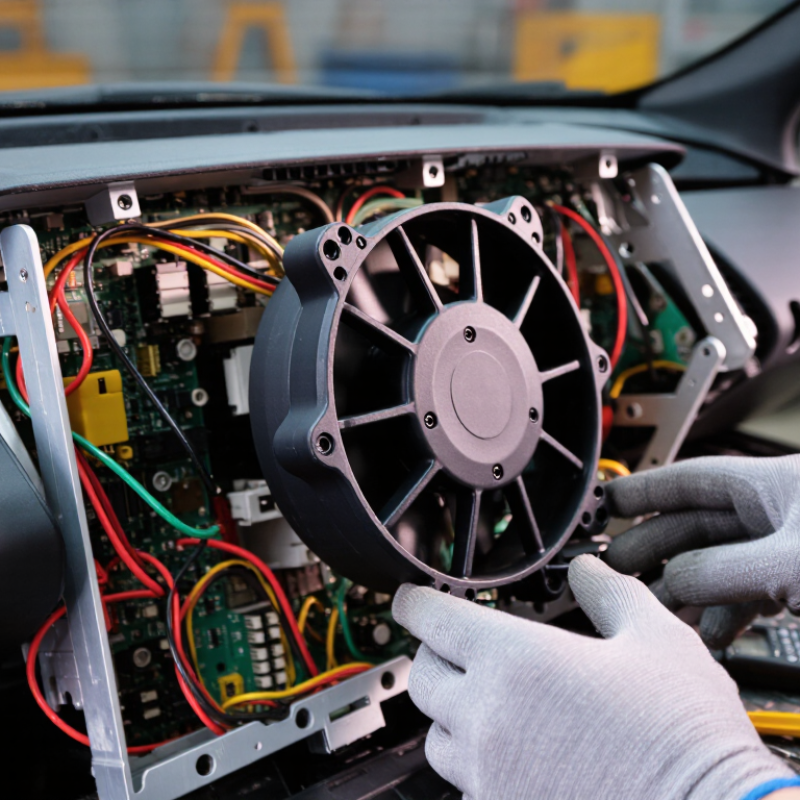
How to Choose the Best Car Vent Fan Supplier?
Define Your Car Vent Fan Requirements and Application Conditions
Start with the vehicle’s real operating environment. Specify supply voltage, airflow, static pressure, noise limits, dimensions, and expected service life. A fan for a parked-cabin ventilation system may run continuously. A dashboard cooling fan may require short, high-speed cycles. These are different engineering problems.
Consider temperature, humidity, dust, vibration, and water exposure. ISO 16750 provides widely used test guidance for road-vehicle electrical equipment under mechanical and environmental loads. Ask suppliers for test conditions, not vague claims. Request airflow curves at your actual pressure point. A fan moving 100 m³/h in free air may deliver far less inside a narrow duct. This detail is often missed.
Electrification also changes the application. The IEA’s Global EV Outlook 2024 reported nearly 14 million electric cars sold in 2023, representing about 18% of new-car sales. Electric vehicles need efficient thermal management and low acoustic output because powertrain noise is reduced. Confirm electromagnetic compatibility, standby consumption, control signals, and compatibility with 12-volt or 24-volt systems. A perfect specification rarely exists. Recheck assumptions.
Tips: Give suppliers a complete application sheet. Include duct size, mounting angle, ambient temperature, humidity, duty cycle, connector type, and noise-measurement distance. Test samples in the vehicle, not only on a workbench. Ask for failure data and corrective-action records. Availability matters too; a technically strong fan is still unsuitable if replacement supply is uncertain.
Use this requirement and supplier-evaluation table to match fan specifications with the vehicle environment and intended application.
| Evaluation Category | Requirement or Data Dimension | Typical Target or Reference Range | Application Conditions | What the Supplier Should Provide |
|---|---|---|---|---|
| Airflow Performance | Rated airflow | Approximately 20–150 m³/h for compact vehicle ventilation and electronics cooling applications. | Cabin air circulation, battery enclosure ventilation, dashboard cooling, or localized heat removal. | Airflow-versus-static-pressure curves measured under defined test conditions, including the operating point required by the system. |
| Pressure Capability | Static pressure | Common small automotive fan systems operate around 10–80 Pa; higher values may be required for ducts, filters, or grilles. | Long air ducts, restrictive vents, dust filters, protective mesh, or compact enclosed housings. | Verified pressure data, test method, fan curve, and confirmation that airflow remains adequate after installation restrictions. |
| Electrical System | Rated voltage and operating range | 12 V systems commonly require approximately 9–16 V operation; 24 V systems commonly require approximately 18–32 V operation. | Passenger vehicles, commercial vehicles, recreational vehicles, agricultural equipment, or auxiliary vehicle systems. | Voltage range, start-up voltage, current draw, reverse-polarity protection, overvoltage behavior, and electrical test records. |
| Power Consumption | Input power and current | Often approximately 1–20 W for compact brushless DC ventilation fans, depending on size, speed, and load. | Battery-powered equipment, continuously operating ventilation, solar-assisted systems, or applications with strict energy budgets. | Typical and maximum current values at relevant voltages, locked-rotor protection details, and low-power operating options. |
| Speed Control | Control method | Fixed speed, three-wire feedback, PWM control, analog voltage control, or digital communication depending on system design. | Manual ventilation, automatic thermal control, noise-sensitive cabins, or electronic control units requiring closed-loop speed feedback. | Control interface definition, PWM frequency range if applicable, tachometer output, minimum stable speed, and sample validation. |
| Noise and Vibration | Acoustic noise and vibration level | Target values are application-specific; quiet cabin systems commonly prioritize low tonal noise and smooth operation below normal cruising conditions. | Passenger cabins, sleeping compartments, operator stations, infotainment areas, or other noise-sensitive environments. | Noise test distance, test room conditions, operating speed, vibration data, balancing grade, and acoustic sample reports. |
| Environmental Protection | Ingress protection | IP rating should be selected according to exposure; protected interior units may need lower protection, while exposed locations may require dust and water resistance. | Interior dashboard, engine compartment, wheel well, exterior vent, under-seat enclosure, or battery compartment. | Declared IP rating, sealing structure, drainage design, connector protection, and test evidence for the intended mounting position. |
| Temperature Resistance | Operating and storage temperature | Typical automotive targets may range from approximately −40°C to +85°C, with higher-temperature options for engine-bay locations. | Cold-weather starting, hot parked vehicles, engine compartments, battery thermal management, or roof-mounted equipment. | Operating and storage limits, thermal derating data, start-up performance at low temperature, and high-temperature endurance results. |
| Material Selection | Housing, impeller, and insulation materials | Use temperature-rated engineering plastics or metal parts selected for strength, heat resistance, chemical compatibility, and dimensional stability. | Exposure to vibration, cleaning agents, oils, coolants, UV radiation, humidity, or elevated temperature. | Material specifications, flammability information where required, chemical-resistance data, and change-control procedures for materials. |
| Durability | Service life and endurance | Continuous-duty designs are commonly evaluated in the range of 20,000–50,000 operating hours, depending on load and temperature. | Continuous ventilation, fleet vehicles, commercial transport, battery cooling, or equipment expected to operate for many years. | Life-test conditions, bearing or sleeve-bearing design, duty-cycle definition, failure criteria, and documented reliability results. |
| Automotive Reliability | Vibration, shock, and electrical transient resistance | Testing should reflect the vehicle mounting location, vibration profile, mechanical shock, and electrical transients of the target platform. | Dashboard, seat structure, roof module, engine bay, chassis-mounted equipment, or mobile machinery. | Applicable test standards, vibration-axis details, shock levels, connector retention results, and transient-protection design. |
| Mechanical Integration | Size, mounting, airflow direction, and connector position | Define overall envelope, mounting-hole pattern, fan orientation, inlet/outlet geometry, and connector clearance before tooling. | Restricted dashboard cavities, custom ducts, replacement modules, seat ventilation, or compact electronic enclosures. | 2D drawings, 3D CAD files, mounting samples, tolerance data, airflow direction markings, and customization capability. |
| Safety and Protection | Rotor protection and fault handling | Consider grille protection, finger safety, thermal protection, stall protection, short-circuit protection, and controlled restart behavior. | Passenger-accessible locations, child-occupied areas, exposed service openings, or systems subject to blockage. | Protection-circuit description, blocked-rotor test results, temperature-rise data, guard design, and abnormal-operation procedures. |
| Compliance Support | Quality and regulatory documentation | Documentation should match the destination market, vehicle program, and customer quality requirements. | Original equipment projects, aftermarket products, export programs, fleet procurement, or regulated vehicle systems. | Quality certificates, inspection plans, traceability records, product-change notification process, and relevant compliance test reports. |
| Supply Capability | Sampling, capacity, lead time, and continuity | Assess prototype lead time, production lead time, monthly capacity, minimum order quantity, and expected supply period. | Short development cycles, phased vehicle launches, replacement parts, seasonal demand, or long-term fleet programs. | Sample schedule, production capacity plan, quality-control checkpoints, buffer-stock options, packaging specifications, and continuity planning. |
| Validation Process | Prototype and vehicle-level testing | Validate airflow, noise, temperature rise, current draw, vibration, environmental resistance, and installation fit before approval. | Any application where duct resistance, mounting resonance, ambient temperature, or vehicle electronics may change fan performance. | Detailed validation plan, test samples, measurement equipment information, corrective-action process, and final inspection criteria. |
Provide voltage, airflow, static pressure, dimensions, noise limits, and expected service life. Include duct size and mounting angle. Small details matter.
Free-air airflow can fall sharply inside a narrow duct or restrictive grille. Test the fan at its real pressure point. A workbench cannot show every problem.
Discuss temperature, humidity, dust, vibration, and water exposure. Ask for test conditions and temperature-cycle results. Vague claims are not enough.
Lower powertrain noise makes fan noise more noticeable. Check electromagnetic compatibility, standby consumption, control signals, and system voltage. Quiet operation matters more.
Look for motor winding, impeller balancing, molding, and end-of-line testing. Request airflow curves, pressure data, and inspection records. Photos prove little.
Confirm the fan diameter, connector, mounting points, voltage range, and control signals. Ask for CAD files and prototype support. Cosmetic changes are not enough.
Compare sample performance with the planned mass-production process. Review batch traceability, warranty terms, and failure-handling procedures. Try a small order first.
Check relevant quality, material, and electrical safety documents for the destination market. Verify scope, expiry date, issuer, and certificate number. A certificate image is not evidence alone.
Calculate landed cost, including tooling, packaging, freight, taxes, inspection, and payment charges. Confirm minimum order quantity and production lead time. Late answers are a warning.
Request pre-shipment inspection and a dated production schedule. Test samples under vehicle conditions. I would still recheck every assumption.
Choosing the best Car Vent Fan supplier begins with clearly defining your requirements, including vehicle type, installation space, airflow needs, operating environment, noise level, power source, and expected service life. Once the application conditions are established, evaluate each supplier’s product quality, performance consistency, safety features, materials, testing procedures, and compliance with relevant industry standards. A dependable supplier should also demonstrate strong manufacturing capabilities, stable production processes, flexible customization options, and responsive technical support for design, installation, and after-sales questions.
It is equally important to review the supplier’s business reliability, certifications, pricing structure, lead times, warranty terms, payment conditions, and delivery arrangements. Before making a final decision, request product samples and conduct practical testing under real operating conditions. Factory audits, production assessments, and feedback from existing customers can further confirm the supplier’s quality control, communication, and service performance. By comparing these factors systematically, buyers can select a capable partner that provides safe, efficient, and reliable Car Vent Fan solutions.

 Yate Auto